"Homo proponit, sed Deus disponit"
— Thomas à Kempis
This is the third and final part of my "Goethe-Zertifikat C1" trilogy. In this part I want to share my thoughts regarding the C2 certification: whether I'm going to do it or not and, if yes, what concrete steps I need to take in order to achieve it. So, let me make God laugh and share my plans with you — and with Him.
To C2 or Not to C2 — That's the Question!
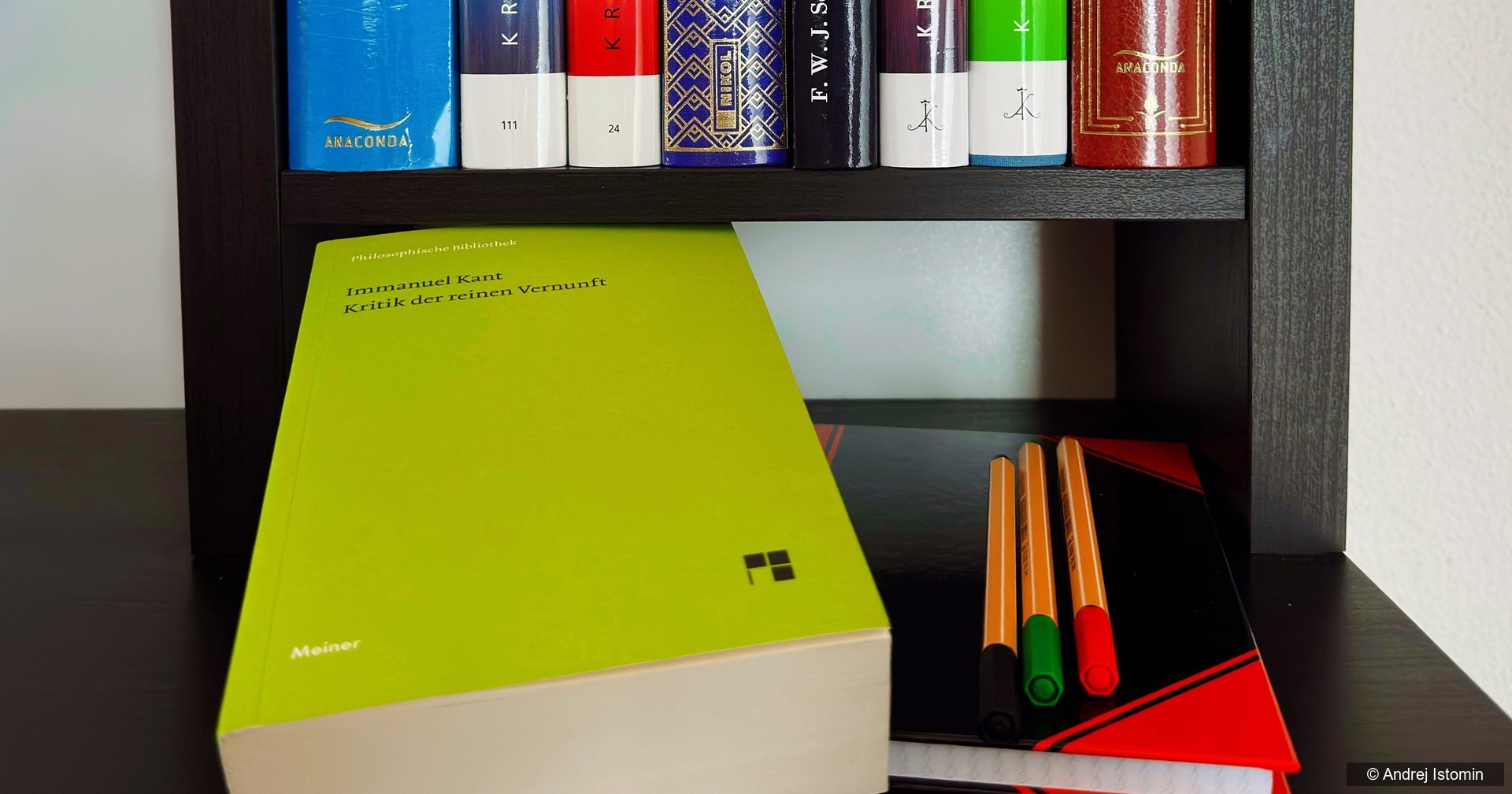
I already mentioned in the previous part that my main reason for getting the C1 level was the desire to read serious German literature and to be able to communicate complex thoughts. But does this level really provide that? In a broad sense, yes: I can read and even understand Kant, I can more or less fluently articulate my thoughts in my work environment. Still, it's not really enough.
What's the point of reading Kant if you can't really discuss it with someone? I'm definitely able to talk about topics more serious than the weather, but I'm far from being able to freely talk about philosophical matters. In some sense it even got worse: on the B1 level you formulate a simple thought, look for the basic linguistic instruments you have (and there aren't many) — and express it. On the C1 level you think you're fluent and often overestimate your abilities — the sentences come out clumsy, stylistically inconsistent and grammatically incorrect. That ruins the whole impression of the speech — verbal or written.
So yes, the C1 level is not something I can be fully satisfied with. The show must go on.
What Is the Plan?
I shouldn't repeat the same mistake I made transitioning from B1 to C1, when I was just "learning German", hoping that it would somehow level me up. Without at least a rough plan this will take years. I have some ideas about what I need to do this time. Let me share them with you.
As it often happens, when going to the next level you have to forget what you learned on the previous one and start from scratch. Yes, I mean the fundament: the grammar. The first unavoidable step is to seriously revisit and master German grammar. Although I understand almost all the concepts, I still haven't mastered them. It's embarrassing when you explain an interesting idea using advanced vocabulary and grammar structures — and then make a silly grammatical mistake. A mistake you immediately notice yourself and think: "What a fool!" This can only be fixed by targeting the grammar topics where I fail and practicing them consciously. I need solid materials to master the grammar. Exercises, exercises, and then a little more exercises.
The second important step is to level up the — what I call — "environment". The surroundings and the application of the language are crucial for me. When I went from B1 to C1, I started using German in my work environment. Now I need to level that up again. How? I'm not the youngest anymore and I have my daily duties, so I can't afford to go to university and study a new subject. What I can do, though, is use German as a hobby philosopher. Philosophy was always my passion. Why not go this way and try to study philosophy in German? Not just read philosophical books, but actually study the subject. Not just passively consume information, but actively process it and turn it into verbal or written artifacts. That would allow me to regularly practice all four areas tested on the exam. Let's look at each of them individually.
Reading. I already have a good library of philosophy books from Plato to Nietzsche. I need to read them. This time the reading can't be passive. I have to study them: actively write outlines and process in detail what I've just read. Maybe even write an essay.
Writing. Combining writing and reading may be a good idea. So maybe "study" is indeed the right word: read about a certain topic, process the information, then write. Maybe I should start a philosophy blog. It's going to be time-consuming, but one can't make an omelette without cracking eggs.
Listening and Speaking. Here I have a problem. Listening to philosophical podcasts or lectures is good, but it lacks the spontaneity of real-time speech. Speaking is even worse: whom would I talk to about my Kantian research? I don't have anyone around me who would be interested in such topics. I was thinking of looking for a — what we Germans call — "Verein" (hobby club, society, association dedicated to a certain topic). We have a Verein for everything: sport, stitching, bird-watching... maybe there's one for philosophy or at least literature. I bet there is; one just needs to take the time and search. Being a member of such a club would allow me to regularly train my speaking and listening skills.
The last and very important step is to prepare for the exam itself. I should not repeat my previous mistake of starting preparation in the last month. I plan to find model tests as early as possible and practice them, if not weekly, then at least monthly. The exam topics must not be overlooked either: climate change, digitalisation — whatever they have on the exam, not necessarily what Kant writes about. I should be aware of those topics and the vocabulary that goes along with them. I also have to regularly make timed tests and maybe even do them in cafés or other noisy places, because distractions and the lack of concentration were among my issues in the C1 exam.
ETA
As I like to say: a plan without time estimations is just a dream. Though I'm sceptical about long-term planning — and the last years with pandemics, wars etc. prove that our plans can be easily ruined by circumstances we cannot control — I still have to give an initial estimation and some time limits to discipline myself.
I may be naive, but I think that two years should be enough to level up: master the grammar, become confident using complex language in verbal and written form, quickly understand complex texts and audio etc. So in two years from now I could actually be on the C2 level. That doesn't mean, though, that I will already be ready for the exam.
This time I want to take way more than one month to prepare specifically for the exam. Ideally 3–6 months, so I can reduce the stress of the last days before it. At that phase — no Kant, just model tests every damn day.
So my ETA is around 2.5–3 years to level up. I'm not trying to be precise; it's just something to start with and not to waste seven years wandering in the dark, as I did with C1.
Conclusion
This post may look like a random rant and dream-sharing, but I want to believe that this plan will be a good starting point on my journey to C2 and help me stay accountable. It won't be easy, and the plan will probably change every month or even more frequently, but it's still better than having no plan at all. It will also be interesting to see how different the reality will be from what I'm planning now. I'll keep you updated if I have something interesting to share on this topic again. Wish me good luck with the preparations!
Thanks for reading — I hope you enjoyed it. See you next time!
Comments are provided by Disqus, a third-party service, and load only when you request them.