In the second part of my "Goethe-Zertifikat C1" trilogy I'd like to share my approach to preparing for this exam and reflect a little on what I think I did right and what I definitely did wrong. I'm not a linguistic expert, so don't expect any professional advice here — the internet is full of people who provide that. I just dare to hope that you'll find something interesting and maybe even helpful in this long post. Grab your coffee and let's get started!
How It Started: B1
Before jumping into the details of my C1 preparations, let's go one step back and talk about my previous experience with the German language and German exams. This can help the reader understand the level at which I started.
I have German roots, and some members of my family spoke the language. This brought me a bit of basic grammar knowledge (like "the verb is in the second position") and some essential words: "ich", "du", "Scheiße", and of course the verb "sein".
With this modest baggage I relocated to Germany in 2015. I hoped to survive with my relatively good English, but that was virtually impossible — especially in Bayern. Moreover, to stay longer I needed a permanent residence permit ("Niederlassungserlaubnis"), and for that I had to prove B1.
Back then everything was easy: I didn't need much preparation. B1 is not a cosmic level, and being fully immersed in a German environment practically replaced studying. I could even say I didn't really prepare at all… not specifically for the exam anyway.
Apps like Duolingo and Memrise helped me learn basic vocabulary and phrases. There were tons of helpful YouTube videos from Goethe-Institut, Deutsche Welle, and others. Since I've always liked football, I tried reading football articles in German. Later, ZDF and its crime series helped enormously — especially with subtitles. But the biggest help came from my Bavarian neighbours: they tried to support my family and me in everything — not only with language but with daily life. That's something I'll be grateful for until my dying day.
Summarising this B1 chapter of my life: "learning by doing" worked perfectly and eventually allowed me to pass the Goethe-Zertifikat B1 in 2018. Three years of effortless, half-passive learning — and I went from 0 to B1. Not bad.
C1. Decision
Every journey begins with a decision. Here came the first difficulty — or rather, the first obvious mistake: I didn't set a clear, reachable goal. I just vaguely wanted to "improve my German" and "speak better one day". This uncertainty cost me five years.
It's not that I wasn't learning German. I was — but unsystematically. I spent hours watching random grammar and pronunciation videos on YouTube, kept watching ZDF crime series, and even started reading easy books like detective stories and light novels. Still, I felt stuck on some sort of plateau. I wasn't moving forward.
At such a moment one must ask oneself whether improvement is even necessary. B1 was enough for simple topics, groceries, small talk, reading newspapers and watching the news. But I wanted more. I often suffered because I couldn't express more complex thoughts. I wanted to read serious literature. My favourite German authors are Kant, Schelling, and Hegel. I once tried Heinrich Mann — it was not enjoyable at all, just way above my level. I also firmly decided I wanted to tie my future life to Germany and get the citizenship. Technically, B1 is enough for citizenship, but I still thought: if you want to live here for the rest of your life, maybe speak the language properly.
As an academically trained engineer, I naturally looked for an academic solution. What would be an achievable goal to formally confirm my progress? In 2023 I made the decision to work toward the Goethe-Zertifikat C1.
At that moment I made mistake number two: a clear goal without a deadline is just a dream. I didn't even research the exam structure or topics. In fact, I started actual exam preparation two years later. Still — the decision existed, and that already pushed my German forward.
My Learning Approach
It was important to understand the objective difference between B1 and C1. Let me introduce a metaphor: B1 is the level of a school pupil or a worker whose duties don't require complex verbal/written interactions. It's a great starting point, because you already understand learning materials in the target language. C1, on the other hand, is a level I'd associate with a school graduate heading to university, or an office worker whose communication skills matter but who doesn't necessarily deal with deeply specialised topics.
I'm convinced that the easiest way to level up is to change your environment. When I first moved to Germany, I switched my PC to German, consumed German news, etc. It worked wonderfully. So: how could I change my environment to fit a C1 endeavour?
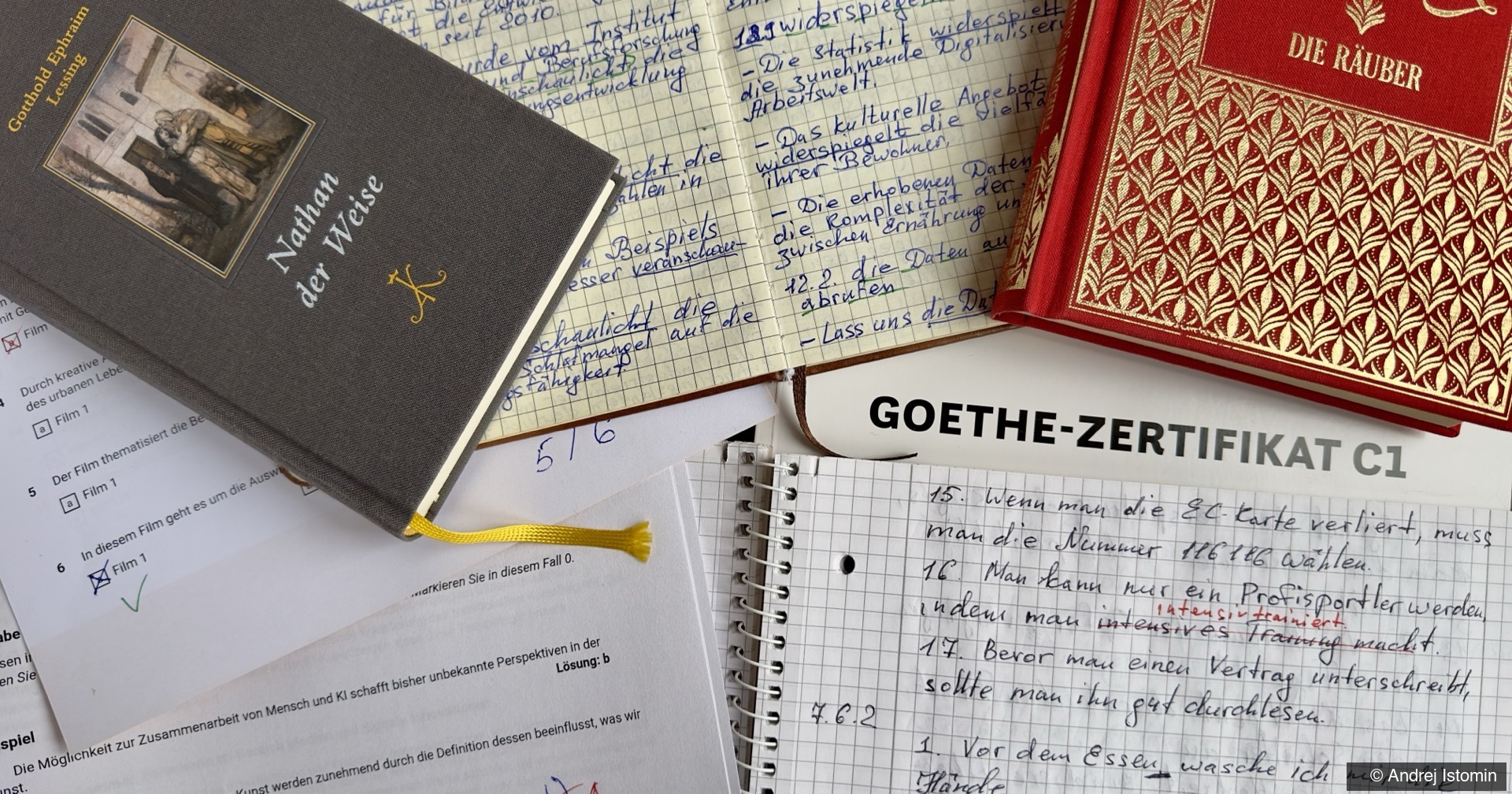
Well, if you want to be like a school graduate, maybe read what school graduates read. I bought Goethe, Schiller and some other guys from classical German literature. Difficult at first — but gradually enjoyable. I should mention the Brothers Grimm: people say their fairy tales are for children and suitable for B1. I strongly disagree. Their vocabulary is far more advanced, definitely C1. It might even be richer than Goethe's 😉
If you want to be like an office worker, then… be one? As a software engineer, I'm kind of an office worker, but the job has its specifics, plus I work in an international company where English is the main language. Fortunately, some German colleagues found my German sufficient for professional communication, and we started discussing our work in German. That helped enormously — not only as practice but also for confidence. I'll never forget their kindness and patience.
Parallel to that, another important factor helped me improve. We had issues with technical support, and it was decided I could help answer emails. A quick support email in imperfect German was considered better than a perfectly formulated but very late one. This became a great writing exercise. Unfortunately, AI later took my job — meaning I got lazy and let AI answer emails instead of writing them myself.
In this way, all four skills — Reading, Listening, Writing, Speaking — were covered in my daily life. But something important was missing: grammar. I'd never learned German systematically, never had proper grammar training. This foundation was missing and affected both the quality of my German and my confidence.
Back in 2023 I bought two online courses from Lingster Academy: "Der komplette Grammatik-Kurs (B1/B2)" and "Der ultimative C1-Kurs (B2/C1)". The first one finally systematised my grammar — from a kaleidoscope of random YouTube bits to a proper understanding of rules and confident usage. The second course gave me an idea of what I should be able to do at C1. It wasn't only grammar; it introduced exam objectives, typical texts, topics, and even allowed me to get feedback from real teachers. Sounds like unpaid promotion 😊
That was my preparation "plan". Looking back, it's clear it wasn't really a plan — more of a "let's do German" approach. If I started again, I'd practise all four exam objectives (Reading, Listening, Writing, Speaking) consistently on a daily basis. I'd also focus more on the exam itself, not only on general growth. I'm still convinced you shouldn't only prepare for an exam — otherwise you sound robotic. But doing a couple of model tests per week to stay familiar with the style and requirements is a good idea. Academic exams are narrow — they expect a specific style that's not necessarily how people speak in real life.
The Exam Preparations
As already mentioned, being at C1 and being ready for a C1 exam are not the same. For me there was no doubt which exam to take: I had Goethe B1, so I wanted Goethe C1. At some point I asked myself whether I might already be ready. It was 2025 — yes, I made the big mistake of only checking exam materials two years after deciding to take the exam.
I took a couple of model listening and reading tests, and the results looked good enough to believe I was close. I also watched the speaking exam video on Goethe-Institut's YouTube channel and was convinced I was stronger than both candidates. Reality later showed that in my exam I was probably weaker than the weaker candidate in that video. One should never confuse an exam situation with an informal conversation or even a routine professional discussion. Anyway, I decided I was ready and booked the exam. It was the end of June 2025, about two months before the date.
The first month was lazy. I kept doing the same things I'd been doing for two years — no acceleration at all. Mostly procrastination and random YouTube videos about the exam instead of preparing. This phase is probably unavoidable: a mixture of laziness, doubts, guilt, and boredom. By the end of the month I started panicking. Only 4–5 weeks left, and I didn't feel prepared at all. Time to act.
I realised I needed help. Luckily Lingster Academy had an intensive course called "C1 Prüfungsvorbereitung". It included various model tests for both Telc and Goethe, a wide range of writing topics for students to submit, and even the option to simulate the speaking part (which I unfortunately never used due to lack of time). They also organise group speaking sessions on Zoom twice a week.
My initial plan for the last 4–5 weeks was to focus on writing and speaking and to do one reading and one listening test per day. Little did I know how much I overestimated my cognitive abilities and energy.
Problem number one: focusing for more than 20–30 minutes was extremely hard. I don't know how I functioned before or how I managed my job, but after taking a timed reading or listening test I felt exhausted for the rest of the day. Doing both every day was impossible; even doing one daily was difficult. I completed maybe two per week. The good news: in the model tests at home I scored around 80/100, so I shifted my focus to writing and speaking. In the real exam I later got 67 and 77 points, for reading and listening respectively. Is that good or bad? Considering I hardly practised them and the exam environment is always different from your quiet home office — I'd say satisfactory. The lesson: occasionally practise under time pressure and in a noisy environment.
Problem number two — no, catastrophe — was writing. For years I'd been writing only on a PC with dictionaries, the internet and AI. I thought my texts were fine… until I tried writing by hand and asked ChatGPT to check them. Epic failure. I couldn't structure thoughts, my vocabulary collapsed to something primitive — and that was without time pressure. I didn't even dare send such texts to my teachers. I started writing small texts daily and checking them with ChatGPT — 3–5 texts a day. It was horrible until the day before the exam. And yet, miraculously, on the exam everything fit together and I wrote two decent texts that gave me 96/100. Courage (or luck) in exams isn't new to me, but it always surprises me.
Speaking was also a weakness, but I hoped that practising writing would give me the necessary vocabulary and the Lingster Zoom meetings would help confidence. As mentioned, I never did a proper speaking simulation because I was too stressed about writing. I simply hoped speaking would magically work out. In the exam I got 85/100 — not a bad result considering I was exhausted and stupidly had a heavy meal before this part, which made me sleepy.
All the specifics of the exam day itself are in Part I of this series.
Conclusion
I should finish this long read somehow, so it doesn't look like a diary of a madman. It's probably the right moment to reflect on what I did right and what could have been done differently.
The good part was focusing on the level, not just the exam. I spent years reading advanced literature and involving myself in situations that forced me to grow. I could have spent this time mechanically memorising phrases for the exam — but that wouldn't have brought me to the next level.
The bad part was ignoring the exam completely. The exam topics, the style, the ability to work under pressure — these things can't be trained sufficiently in one month. Had I practised them once a week during the previous two years, my results would have been significantly better, and I might have been ready earlier.
Overall, I'm satisfied with the experience. There was a lot to learn — not only about the exam, but about my general ability to perform intellectual work. Lack of planning, lack of concentration — all these things matter. I hope to improve them and apply them next time. But we'll talk about "next time" next time 😊 In the next post.
Thanks for reading, and see you soon!
Comments are provided by Disqus, a third-party service, and load only when you request them.